
MGE's 2026 Peregrine Falcon Chicks' Names Inspired by Pollinators
MGE welcomes Honey and Monarch to the family, which now includes honey bees!
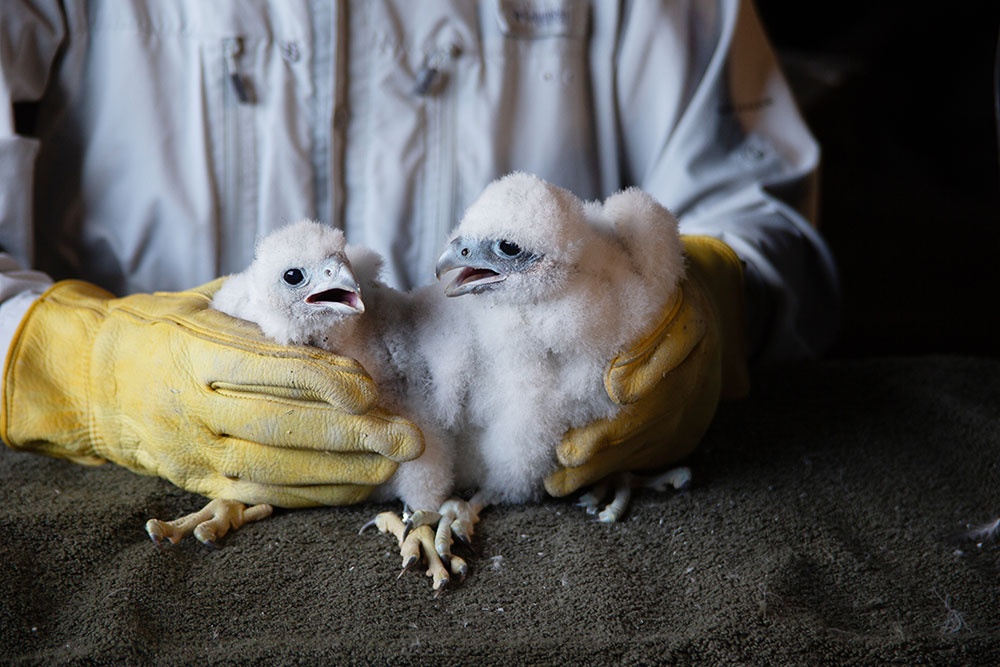
Madison, Wis., June 2, 2026—Madison Gas and Electric (MGE) today announced the names of the two peregrine falcons that hatched in the nesting box at our downtown Madison Blount Generating Station last month. This year's names, Honey and Monarch, celebrate pollinators.
A pollinator is a bee, butterfly or other agent that transfers pollen from one plant to another. Pollinator habitats are shrinking nationwide, reducing food sources and nesting areas for bees, butterflies and other insects vital to pollinating plants and supporting food production. MGE, in partnership with vegetation consultants, establishes pollinator habitats by planting native seed mixes at MGE-owned and operated solar sites.
Falcon Banding at MGE’s Blount Generating Station
Wisconsin peregrine falcon expert Greg Septon banded the chicks at Blount this morning. The bands allow experts to track the birds throughout their lifetimes.
Honey, a female, was named for honey bees. Earlier this spring, MGE welcomed honey bees to the O'Brien Solar Fields in Fitchburg, one of the Company's initial pollinator sites. In partnership with a local beekeeper, five bee hives were set up and a colony of honey bees now resides at the solar array. The bees collect nectar from some of the native pollinator plants at the site, contributing to the ecosystem.
The plantings at MGE solar facilities provide nectar and forage for pollinators from spring through fall. This process enables fertilization and the production of food such as seeds, fruits and nuts.
Monarch, a male, was named for monarch butterflies. One of the biggest impacts on the monarch population is the loss of habitat for breeding, migrating and overwintering. Monarch butterflies need habitat for both their caterpillar and adult populations. At three of our MGE-owned and MGE-operated solar sites, our native seed mixes were planted to support the monarch's life cycle from egg to caterpillar to adult. This was accomplished by planting several types of milkweed and native plants that will flower throughout the monarch season in Wisconsin.
MGE Resident Falcon Trudy Returned for Her 12th Year
Trudy, the female falcon, laid four eggs in April. This is the 12th year Trudy has returned to the MGE nesting box. Her mate is an unbanded falcon who is new to the MGE nesting box this year. Two eggs did not hatch this year. Despite these eggs not hatching, MGE's falcons have a hatch rate of about 90% over the last 15 years. A normal hatch rate for a site is around 75%. The chicks will soon learn how to fly and eventually depart the nesting box.
With Honey and Monarch, 63 falcon chicks have now hatched at Blount since 2009, when the birds first began nesting at the power plant. MGE installed the nesting box in 1999, as falcons tend to prefer power plants and other tall buildings as nesting sites.
The peregrine falcon is listed as endangered in Wisconsin. Due to pesticide use in the 1960s, peregrines were declared extinct in the state. Falcons were reintroduced in the 1980s and have made a slow, steady comeback due to statewide efforts and nesting boxes like the one at Blount. For more information on MGE's falcons, please visit mge.com/falcons.
About MGE
MGE generates and distributes electricity to 170,000 customers in Dane County, Wis., and purchases and distributes natural gas to 180,000 customers in seven south-central and western Wisconsin counties. MGE's parent company is MGE Energy, Inc. The company's roots in the Madison area date back more than 150 years.
Steve Schultz - Corporate Communications Manager
Madison Gas and Electric
608-252-7219 | sbschultz@mge.com
